How To Read FiddleHed Tabs
🎯 What You’ll Learn
In this lesson, you’ll learn how to read FiddleHed Tabs—a simple and beginner-friendly way to figure out which fingers go where. Tabs don’t replace your ears, but they give you a handy visual guide as you learn by listening and playing.
We’ll explore this system in bite-sized chunks, using repetition and easy examples (like “Oh Susanna”) to help it stick. You’ll build muscle memory, recognize finger patterns, and get a feel for how tab notation fits into your learning journey.
🛠 Key Tips
-
Tabs show finger numbers, not rhythm—use your ears and the play-along tracks to hear the groove.
-
Say the finger numbers out loud as you play to reinforce them.
-
Think of tabs as a memory jogger—not a complete roadmap.
-
Brackets help group notes together—use them to see musical phrases.
-
If you see two notes stacked, that’s a double stop—try plucking it first, then bowing.
-
Don’t stress about getting it perfect—just keep looping and listening.
❓ Common Questions
Do tabs tell me the rhythm?
Nope! Tabs show you which fingers to use, but the rhythm comes from listening.
Can I just use tabs forever?
They’re great to start with, but learning standard notation will open more musical doors over time.
What does it mean when two notes are stacked?
That’s a double stop—two strings played at once. Start by plucking both together to get the feel.
First quarter
Example: Oh Susanna
(D0-1)-2-A0-0-1-0-D2-0-1-2-2-1-0-1
Second quarter
(D0-1)-2-A0-0-1-0-D2-0-1-2-2-1-1-0-0
Third quarter
D3-3-A1-1-1-0-1-0-D2-1-1
Fourth quarter
(D0-1)-2-A0-0-1-0-D2-0-1-2-2-1-1-0-0
To make the tabs easier to read, the letters don’t change if you’re on the same string.
For example, A0-1-2-1-D3 means you play four notes on the A string-open A, first on A, second on A, first on A, and then third on D string.
Duplicated parts are color coded to make them easier to read and to give you an overview of the structure. In the example above, the second and fourth quarters of the A part are identical so they are both color-coded red. Gray text indicates unique parts.
Brackets
( ) Notes in parentheses at the beginning of a tune or part indicate that this is a “pickup” to be played before the part. They lead smoothly into the part.
[ ] Brackets indicate that the notes are played as a triplet which is counted 1-2-3.
Notating two notes at once
D0A0=Double stop with open D and A
D1A0=Double stop with 1st finger on D (E note) and open A
Slides
⬆=Slide up to a note
⬇=Slide down to a note
Further learning
Left-Hand Finger Numbers
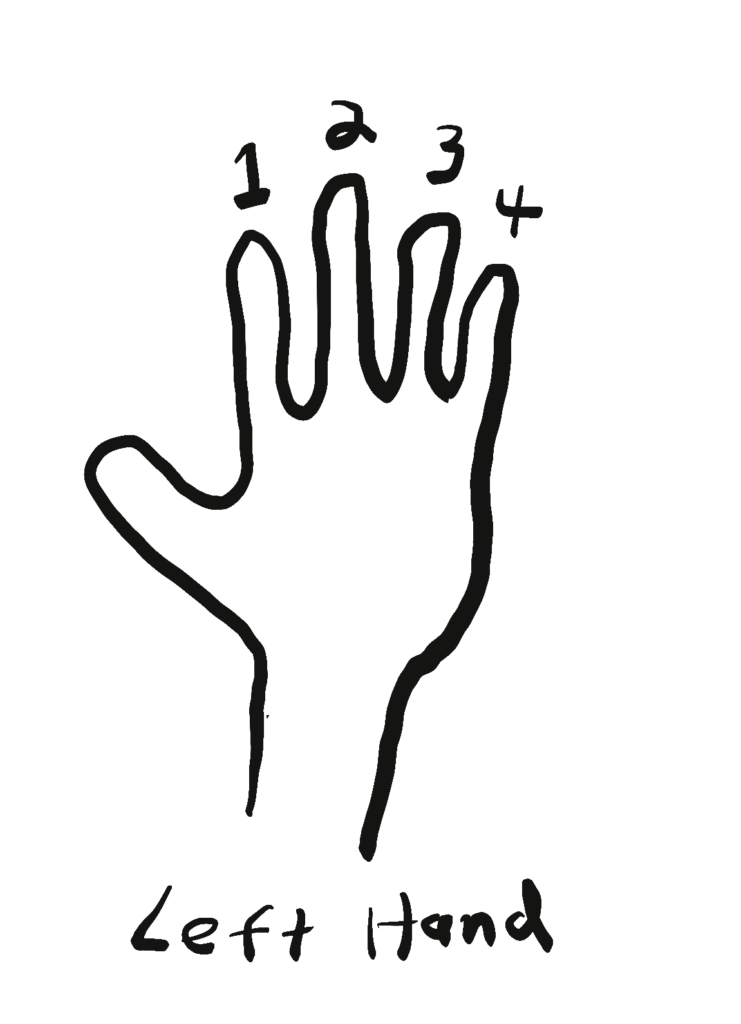
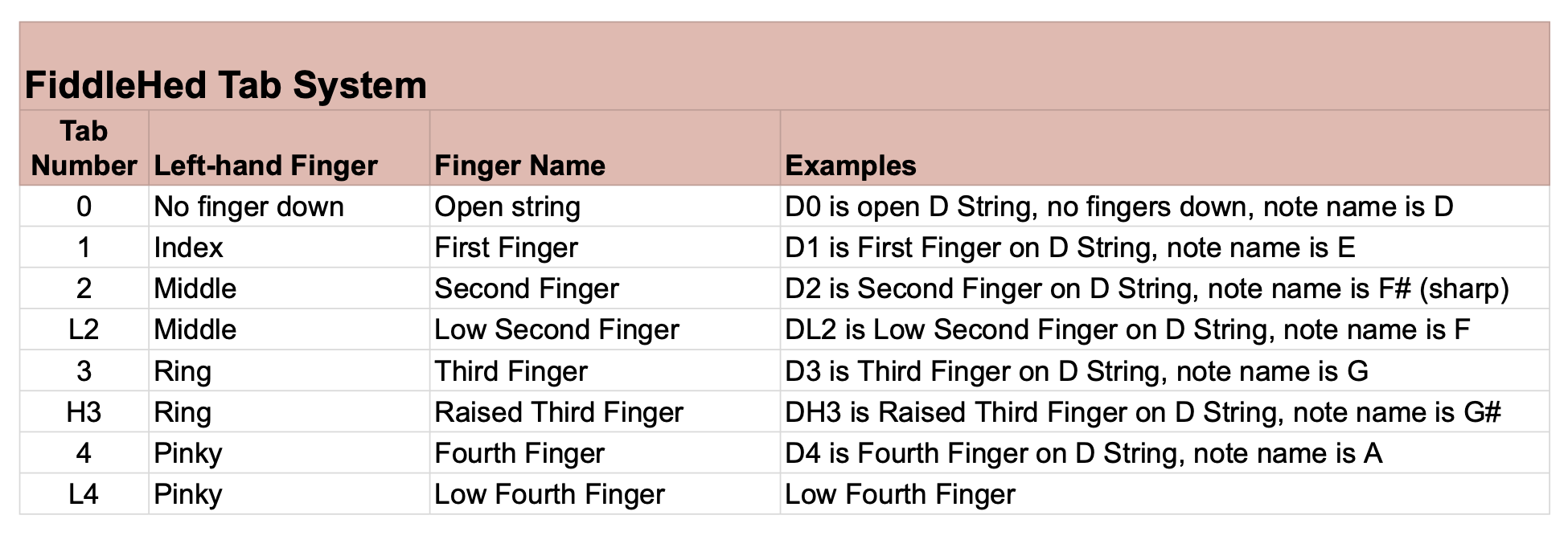 Download and print:
Leave a Reply
You must be logged in to post a comment.
This is the first time I encountered the “double stop”, namely in the call-and-responses, so I had to google it. It means to play two strings at once.
Hi Adam, great point on that term. Thanks for sharing your experience and the definition you found.
Also, here are a variety of lessons and posts related to double stops on FiddleHed:
https://staging.fiddlehed.com/?s=double+stop
I can read music but I’m not very fast at it so tabs help me a lot. To help me, I print out the sheet music and write the tabs over each note. By viewing the notes, I can tell if I should be playing eighth notes, quarter, or half notes. After I write the tabs, I study each measure and clap out the notes to get a better sense of the timing. I like your idea of saying the notes out loud as I play.