Oh Susanna
🎯 What You’ll Learn
“Oh Susannah” is a great tune for beginning fiddlers—it’s familiar, fun to sing, and surprisingly rich in learning opportunities.
You’ll work through each musical phrase in quarters, build muscle memory with looping, and explore ways to simplify tricky sections.
Plus, you’ll learn how to use singing and micropractice to truly make this song your own.
🛠 Key Tips
-
Warm up with the D Major scale—it’s your tune’s home base
-
Loop the first quarter—it shows up again and again
-
Use “stop and rock” to clean up your bow arm
-
Try singing the tune before playing—it plants the melody in your brain
-
Break down tricky parts into smaller chunks (even one note!)
-
When in doubt, simplify and repeat
❓ Common Questions
Do I need to use sheet music for this?
Nope! You can learn by ear, by tabs, or both—whatever works for you.
What if my string crossings sound messy?
Pause between notes with “stop and rock” to give your arm time to adjust.
Can I skip the singing?
You can—but it really helps. Even humming counts!
Learning chunks
Preparation
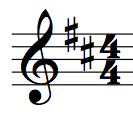
Warm up with the D major scale and phrases from the tune (once you’ve learned it) using a D drone:
First quarter
Warm-ups
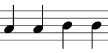
Key intervals:
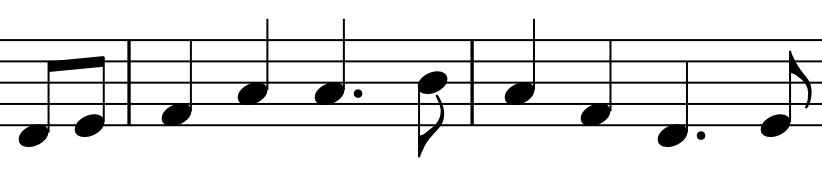
D2-2-A0-0
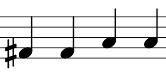
A0-0-1-1
⬇
(D0-1)-2-A0-0-1-0-D2-0-1-2-2-1-0-1-1
Sing then play: Well I come from Alabama with a banjo on my knee

Second quarter
D0-1-2-A0-0-1-0-D2-0-1-2-2-1-1-0-0
Sing then play: Going to Louisana, my true love for to see
Third quarter
Warm-ups
Key intervals:
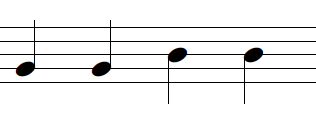
D3-3-A1-1
⬇
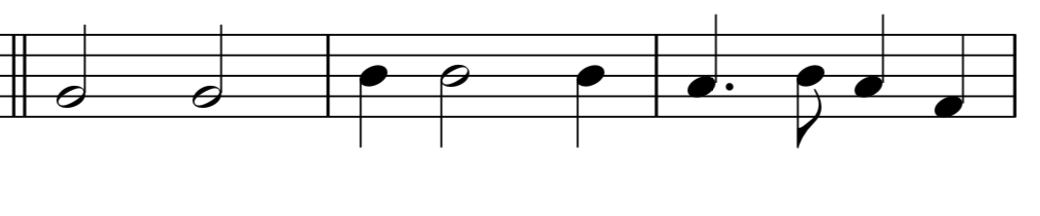
D3-3-A1-1-1-0-1-0-D2-1-1
Sing then play: Oh Susannah, oh don’t you cry for me
Fourth quarter
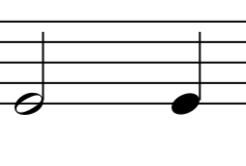
D0-1-2-A0-0-1-0-D2-0-1-2-2-1-1-0-0
Same as second quarter.
Sing then play: Cause I come from Alabama with a banjo on my knee
Interlude
Let’s pause for a moment and pay attention to how we practice.
Micropractice
When something is challenging, see if you can simplify the problem. Practice things in small increments.
You may find there is just a single note which is causing the struggle. If you can find that and practice it, then you systematically eliminate all hard parts. Once you get better at a small piece, test yourself by playing a bigger piece that includes it.
If you take this approach to heart and actually do it, then you can eventually learn anything.
Other versions on Youtube
Further Practice
Practice the song at your own pace with this drone track
Drone in D – No Beat
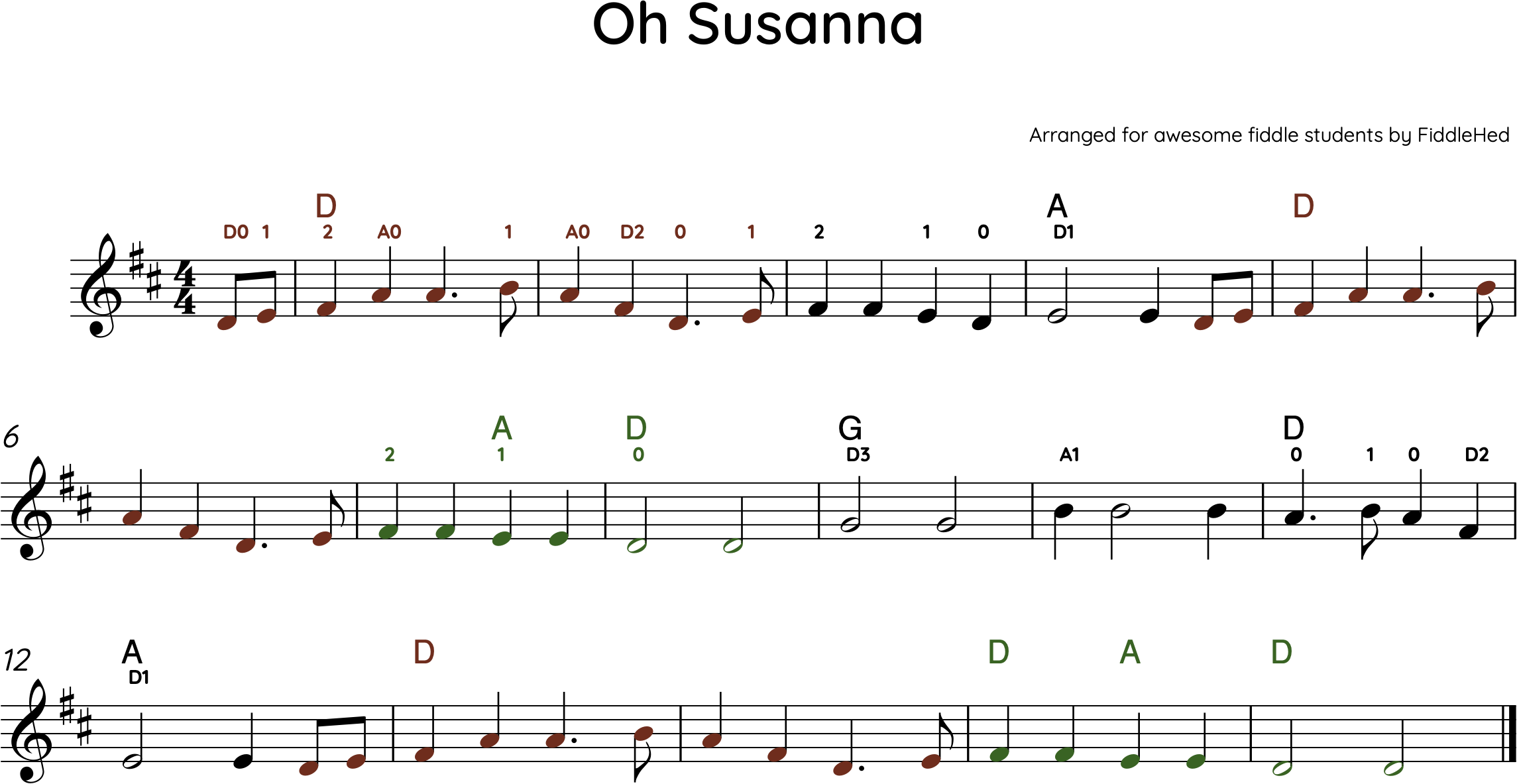
Full Tabs, Audio & Sheet Music
First quarter: D0-1-2-A0-0-1-0-D2-0-1-2-2-1-0-1
Second quarter: D0-1-2-A0-0-1-0-D2-0-1-2-2-1-1-0-0
Third quarter: D3-3-A1-1-1-0-1-0-D2-1-1
Fourth quarter: D0-1-2-A0-0-1-0-D2-0-1-2-2-1-1-0-0
Basic Mix
Jam mixes
These alternate between the melody and fiddle chords (without vocal). Use the chord sections to practice the basic melody, vocals, chords, variations or improv.
60 bpm
Multi-tempo
Sheet music video
Learn to intuitively read sheet music with this animated video. If you’re an absolute beginner, then I suggest you don’t worry about fo it for the moment.
This is here for continuing students who want to learn about sheet music. It’s part of the Note-Reading For Fiddlers course.
Continue on to D Major Scale >>
Return to top of Module 1.3 >>
Leave a Reply
You must be logged in to post a comment.
I am searching to see were to start, I played the fiddle 17 years ago Just good enough that the average person could not tell I didn’t know Jack, But then I had a very bad finger accident that took 2 years to heal and a couple more before i could start using it. That set me back, I have picked up my fiddle now and then but just a few months ago got tired of waiting time on internet and social media
and started practicing a lot, I never understood cords. Played a lot on memory. I hope between your teaching and some privet lessons I will not Run my dog or Wife out of the house.
So much fun and so useful to have these tracks to play with
Oh yeah.adding to previous post…I did check out the common chords piece and I’m going to have to work on “tips of fingers” to keep from muffling up the sound of the double stops. Wife yelled from the other room her approval of the sound coming from the chords so I must be doing something right a little…
Not too shabby with getting oh Susannah added to my playlist. Really like the 60bpm Jam mix with chords. That is gonna take me a while but it sounds so good. Can you put the sheet music for that on here? I’ve no clue how to find them to make it come together for the tune.
Hi Sam! Nice going, thanks for sharing your ways 🙂
The Sheet music on this lesson includes the basic chord progressions where the letters are capitolized above where they happen in the song, continuing with the same chord until it shows a different letter.
Please reach out anytime! Awesome to hear your progress mentioned above as well 👍🏼
Test
When changing between the respective quarters, my challenge was to end with the upstroke of the bow so that I could start with the downstroke for each quarter. Otherwise, I had a restlessness in the bow because I had started sometimes upwards and sometimes downwards. And when I had found the finger/bow combination, it became difficult with the increasing tempo because I played more uncleanly or played the fingers per bow stroke differently as it got faster. But now it feels good on the violin with the bow, even at a faster tempo.
Hi Gabi, nice to hear your process, struggle, and growing through it. It’s a great point, bowing patterns change in various instances, especially when changing tempo.
Good to get familiar with various bowing directions throughout the practising process, to support freedom of what arises in the moment. Thank you for mentioning this 👍🏿
Fun
Yes 🙂
I thought I had this song in the bag before trying to keep up with the fast tempos. I’m sure muscle memory (or carpal tunnel) will be formed by the time I can play it through lol
😀 Thanks for sharing the fun and surprise in this for you. Many levels to getting to know something well. Happy fiddling, Heather!
OMG
I don’t read music, but think I uncovered something for myself – the sharps f and c in Oh Susanna – mark the key the song is in. Is that true?
I have heard that songs often begin and/or end with the first note of the key they are in. 🙃
Hi Lulu, great intuitive noticing 🙂 yes, the first section on the sheet music (where the sharps/flats/or none are listed) helps refer to what key the song is in, in this case D major. And yes indeed, in this song, the start and end note includes that D note, which can, at times, relate well to the key of the tune.
You may find these sections on FiddleHed interesting to dabble into:
https://staging.fiddlehed.com/courses/note-reading-for-fiddlers/
‘Note Reading’ tab
https://staging.fiddlehed.com/fiddle-questions/
Great to slowly integrate realizations and theory components as we’re drawn to it 🎶
I like the lesson and the song very much, what I found difficult at first were the first notes at the beginning, the song starts so dynamically, it took a while until I could play along with the melodies here, but now it’s slowly getting better. The sheet music video helped me at the beginning because it was slower than the melodies. Thanks for that lesson. 🙂
Hey Gabi, I agree! Yes, great sharing on experience with the pick up notes at beginning and how the tune starts out with pretty good jumps in notes. Neat to hear your progression too. Thanks for expressing how you resonate with the lesson presenation. Happy Fiddling to you 🎵
I would really like some feedback on my playing. I’ve only been playing for about two months and this is probably the second or third time I ever played this song.
Holly, Thanks for sharing this video. I created a feedback video for you and posted it in the Student Videos page (under the Community tab)
https://staging.fiddlehed.com/forums/topic/oh-susannah-with-feedback/
I’m not as fast as the drone so I guess I need more practice. I’m loving fiddlehed. I’ve got another core song memorized and I’m even playing it with double stops. This is so much fun. People keep telling me that violin is hard. It’s not hard for me. Keep up the good work.
Hey Holly, I’d be interested to hear more about the drone and speed you’re playing at.
Thanks for sharing your experience with Fiddlehed, your motivation and perspective is inspiring 🙂
I’m not using a drone. I’m just playing it by ear and with the sheet music. I know how to read music so all I had to to is play the music as I saw it.
I don’t see audio for the second quarter!
Hello Josué,
Thanks for mentioning this. We’ll get this added when we can.
In the meantime, hopefully you can make use of the full play along track to help learn that section as well as the sheet music and tabs.
The 2nd quarter mimics the 1st quarter other than the last 4 notes: D1-1-0–0– (instead of D1-0-1–1-01)
I really like playing with the drone and like that your play along track has a guitar in it. I’m a guitar playing dad, who’s keeping up with his young daughters learning classical violin, but personally like fiddle music better, so ultimate goal is to play my guitar with my kids on fiddle around the camp fire. So I’m learning the fiddle songs first, then teaching the kids, then back to guitar, lol. Need more time in life…Your lessons are fantastic. This is a fun easy song to start the family band on. thanks.
Ive been fooling around with this song for quite some time, but now with this play along track.. it launched me forward and re-focused reading music instead playing by ear/ memory. Thank you ! Awesome !!
Wow! I can actually play this song! I am learning so much. Thank you – the drone practice is so darn magical.
Love the play along track! It’s a lot of fun and a great way to practice chords while you sing!
Me too! I love the play along track. This practice was so fun!
[youtube]
Great job!
I just love this catchy tune. My 9-year-old was playing this on the piano and I wanted to play along with him. Of course, FiddleHed would have a tutorial on “Oh Susanna”! You seem to have every tune I have ever wanted to play. Thank you for making learning so easy and fun.
Hey @RiverLotus, glad you like this tune. It comes up over and over again throughout the course.
Hi Jason, does the variation that plays at the end of the playalong track come up in the course? I’d love to play it but I’m afraid my ear is not yet developed enough to learn from the audio!
I love the variation you put into the play along track! It makes practice fun! Really loved to hear you sing, felt like I was in a band and made it even more FUN!!!!
Working great for me. Now I want to learn to play like at the end of that play-along track!
Great! Go for the gold!
I wasn’t getting any error message. When I would tap on the button to play a track it merely would flash the perimeter. It wouldn’t extend nor play.
I rebooted my phone, closed the browser, signed out, etc. to know avail.
However, it works right now this Saturday morning Oct 19.
Now no sound tracks are working!
What type of error messages are you getting? This may helps us to determine the right solution.
Thanks Sharlyn for all your hard work!!