
Melodius Double Stops Workshop
🧭 Overview
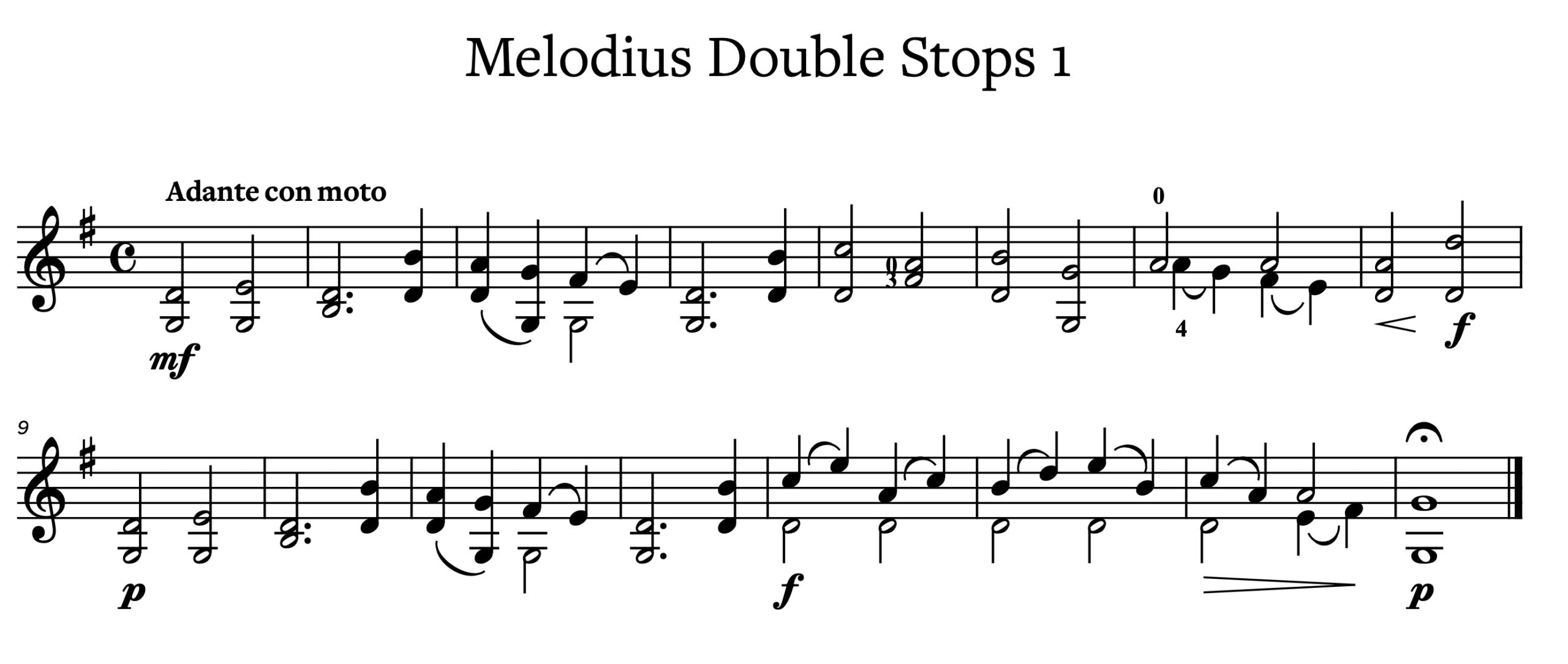
Ready to add depth and richness to your fiddle sound? In this workshop we stroll through Exercise 1 of Melodious Double Stops by Josephine Trott—a classical etude with a secret life as a fiddler’s playground.
We’ll strip the tune down to its bare melody, layer single-finger “droning” double stops, and finish by sprinkling in bowing, slurs, and rhythmic variations (hoedown, triplets) so you can play this exercise in any style you like.
🎶 Practice Content
Single stops
Double stops (original exercise)
Double stops hoedown
🪜 Learning Steps
🎻 1. G-Major Warm-Up
Play a slow G-major scale—first as single notes, then as droning double stops. Aim for an even, relaxed tone on both strings.
🧩 2. Learn the Bare Melody
Isolate the first four bars on single notes (call-and-response style). Focus on intonation and finger comfort before touching any harmonies.
🤝 3. Add Double Stops
Start with open G & D, then G1/D0 → G2/D0, and so on.
Listen for balanced volume; adjust bow pressure if one string shouts over the other.
🛠️ 4. Troubleshoot Tricky Spots
The main hurdle is the four-note pivot G2D0-G2D0-D0A1-D0A1. Strip away slurs, slow down, or even pluck instead of bow until that left-hand move feels natural.
🌀 5. Create Practice Loops
Loop bars 6-8 (the “D4 + open A” moment) until the shift lands cleanly. Use long holds or mini-rests to reset your bow without losing flow.
🎶 6. Sprinkle in Rhythms & Slurs
Re-introduce written slurs, then experiment with fiddle feels:
• Hoedown (long-short-short-long)
• Triplets
• “Jig-ify” the phrase in 6⁄8 time
🔍 Reflect
What did I learn?
What doesn’t yet make sense?
What can I improve next session?
Workshop-specific prompts:
- Where did double stops boost my sound the most—intonation, resonance, or comfort?
- Which rhythm variation (hoedown, triplet, jig) felt natural—or hilariously awkward—and why?
- Did chunking the tune into micro-loops speed up learning? Where did I get stuck or surprised?
📝 Summary
- Warm-up on a slow G scale, then add droning double stops.
- Master the melody first; double stops come second.
- Master pivots like G2D0-G2D0-D0A1-D0A1 with slow loops and plucking.
- Layer in slurs, hoedown, triplets, and jig feel for creative practice.
🚀 Further Learning
Repeat the warm-up/double-stop layering on other G-major tunes.
Record yourself and listen for balanced volume between strings.
Try the exercise in D-major (open D & A drones) to internalize the concept.
- Memorize the first four bars
- Then start on D and A strings: D0A0-D0A1-D2A0-A0E1 | A0E0-D0A3-D0A2-D0A1 | D0A0
Related FiddleHed lessons:
Other versions on YouTube
Start with this full walkthrough of Book 1, Exercise 1 to set a strong foundation.
Then add depth with this technical tip-focused video to refine execution.