
Little Liza Jane
🎯 What You’ll Learn
In this lesson, you’ll learn the classic fiddle tune Little Liza Jane by ear—step by step, one chunk at a time. We’ll build the melody using a powerful combo of call-and-response, singing, and looping. This approach not only helps you memorize the tune but also improves your timing, tone, and musical ear.
We’ll focus on each quarter of the A and B parts before piecing it all together, so you never feel overwhelmed. Whether you sing, hum, or just listen, the tune will sneak into your fingers—and your heart—in no time.
🛠 Key Tips
-
Start by playing the D major scale—it’s the backbone of this tune.
-
Try singing or humming each line before you play—it really locks it in.
-
Loop each phrase by singing then playing, or just playing twice in a row.
-
Break the tune into quarters and practice one chunk at a time.
-
Repetition is your friend—come back to tricky lines often.
-
Don’t rush to play the full tune until the pieces feel solid.
❓ Common Questions
Do I have to sing?
Not at all! Humming, whistling, or even just listening does the trick. But singing can really help it stick.
Can I just play the whole tune right away?
It’s tempting, but you’ll learn much faster—and with better rhythm—if you master each small part first.
What if I get lost in the rhythm?
Try clapping or tapping along first, then loop short lines until they feel natural. Timing will come with trust and time.
Learning chunks
Preparation
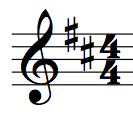
For those of you who read (or want to read), all snippets use this key and time signature:
A part, first half
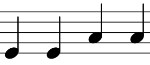
Intervals
D2-2-A0-0
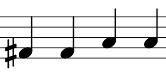
D1-1-A0-0
↓
A part, first bar: D2-2-2-1-0-2-A0-1-0
A part, second bar: D2-2-2-1-A0
↓
A part, first half
First half: D2-2-2-1-0-2-A0-1-0 D2-2-2-1-A0

Well, I got a girl that’s so good to me, Little Liza Jane
Learn With Chunking
If you want to learn a new song, Then don’t try to play the whole thing right away.
Break it down into small manageable Chunks.
Let’s really learn the first bar D2-2-2-1-0-2-A0-1-0.
Maybe you discover the hardest Chunk within that is D2-A0-1-0
Then Go Slow with single reps, giving your fingers time to reach their destination.
When it feels comfortable, Loop that chunk
Repeat the process with the other Chunks.
Then, Chain the Chunks together into larger parts.
A part, second half
First and second halves of the A part are the same except for the last note.
A part, second half: D2-2-2-1-0-2-A0-1-0 D2-2-2-1-0

Well, now she ain’t more than five foot three, Little Liza Jane
B part, first half
Intervals
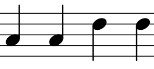
D0-0-3-3
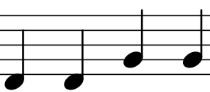
A0-0-3-3
↓
B part, first bar: A3 0-0-1-0
B part, second bar: D2-2-2-1-A0
↓
B part, first half
First half: A3 0-0-1-0 D2-2-2-1–A0

Oh, Little Liza, Little Liza Jane
B part, second half
First and second halves of the B part are the same except for the last note.
Second half: A3 0-0-1-0 D2-2-2-1–0
Oh, Little Liza, Little Liza Jane
Further Learning
You can use a song like Little Liza Jane to practice a challenging skill like Singing What You Play.
Here are the steps to improve your skills:
- Warm up by playing a simple version of the song.
- Then just sing the song.
- Then practice alternating between singing and playing small chunks in a loop like “I gotta girl”.
- And then loop on bigger chunks.
Singing what you play is a fun way to develop your ear. It will help you to play in tune, learn melodies and jam with others.
The advantage of practicing this with simple songs is that you know them really well. So you can put all your attention on the challenging skill of singing what you play.
Learn more here: Learn Violin With Familiar Songs
Other versions on Youtube
Full Tabs, Audio & Sheet Music
A PART:
First half: D2-2-2-1-0-2-A0-1-0-D2-2-2-1 A0
Well, I got a girl that’s so good to me, Little Liza Jane
Second half: D2-2-2-1-0-2-A0-1-0-D2-2-2-1 D0
B PART
First half: A3 0-0-1-0-D2-2-2-1 A0
Oh, Little Liza, Little Liza Jane
Second half: A3 0-0-1-0-D2-2-2-1 D0
Oh, Little Liza, Little Liza Jane
Jam mix – 60 bpm
Jam mix – multi-tempo
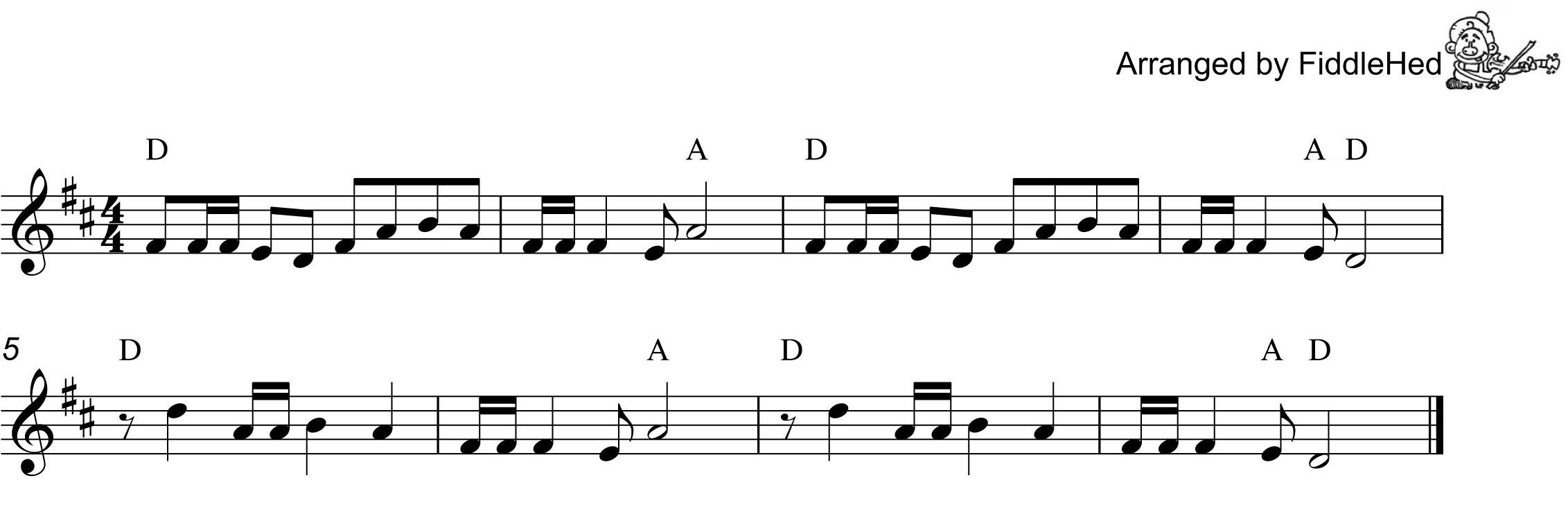
Sheet music video
Learn to intuitively read sheet music with this animated video. If you’re an absolute beginner, then I suggest you don’t worry about fo it for the moment.
This is here for continuing students who want to learn about sheet music. It’s part of the Note-Reading For Fiddlers course.
Continue on to Interval Exercises I >>
Return to top of Module 1.3 >>
Leave a Reply
You must be logged in to post a comment.
A question about bowing: On the demonstration video Jason is slurring some notes, but this is not mentioned in the video and thus far there has not been anything about bow directions when playing tunes. Should we try to follow the bow directions from the video? Or would it be beneficial to try to keep to a single bow direction pattern on every repeat? Or should we just wing it at this point?
Hi Jari, great points you raise on bowing patterns. As we experience Jason’s bowing for this song, when he initially plays it through, he is creating natural slurring patterns as he goes, likely what feels best while he plays.
For folks learning a new song and in a beginner situation, it can be helpful to start with separate bows. This can help with getting rhythm solid and support focusing on doing the basics well. That being said, it can also be beneficial to simply let the slurring of notes occur naturally as we play. Following a specific bowing pattern (such as what we see Jason doing), can be a fun challenge, and can also take a lot of specific focus to make happen. I usually work with what slurring I feel good in doing, and this can change over time with various speeds in playing, styles of playing, state’s we’re in, etc.
Some further ideas with practising related to this: play with separate bows, play with separate bows while starting with opposite bow direction (so our up and down bows are switched), and also let oneself slur where it feels good to, and more! Try a variety of ways 🙂 Happy fiddling.
I should be more specific..would you do a hoedown rhythm for the chords or something else?
Hi Kayli, great topic you raise.
At first glance with the tune, when singing the melody and chording with fiddle, I naturally want to ‘chuck’ the off beat (I look at a bar/measure in 8 counts-instead of 4, chucking beats 2,4,6,8). For the A chords and AD chords (as you mention), I’d lean towards chording 8th notes, breaking the off beat for those.
Another fun thing to try is playing chords with the same rhythm of the song, that can be a great practise.
I’d imagine the hoe down method is great as well, and a good challenge!
Fun thing with chording is how open ended it is with what rhythm you feel like doing throughout. I usually like to switch it up throughout.
Here’s a version Jason shared which has the off beat being clapped throughout:
https://staging.fiddlehed.com/blog/tune-of-the-week-little-liza-jane/
Be great to hear what you create with this 🙂
Thank you Jocelyn! Your ideas are really helpful and something good to think about as I develop how I use chords more. I appreciate it!
Chord backup for this seems like it would sound a little different than usual considering the fourth and eighth measure chords/rhythm. Please consider sharing how you would approach this. Thanks!
Good afternoon, this is tricky. I’m counting the beats (like I do) and kept messing it up I guess in the second and fourth stanzas. So, your approach made the most sense–nuts–when I started singing (badly or “la, la, la”) I finally got it. I thought I would be through this lesson quickly but I’m going back until I get it. I was hoping to record this one. It’s more than just a simple “familiar” tune, isn’t it? All the best, Rosalie (werbose)
Thanks for sharing this, Rosalie. Singing and rhythm tapping with body, in any fashion, helps so much! Great your experiencing deeper dimension to the tune too 🙂
Hello. I’m just starting. How do you know when to move to the next tune?
Welcome Linda, Thanks for reaching out 🙂 Good to hear your getting going. Here is some guidance from within the ‘Support’ tab ‘How to use FiddleHed’. I encourage you to skim through the Support pages to have a good sense of what’s offered there.
How long should I stay with each lesson?
As a general principle, strive to make everything good, not perfect.
Time lengths will vary for each student. For a brand new tune or exercise, I recommend 1-2 weeks.
You want to be able to reliably make it through each tune and exercise with flow. Can you play it three times in a row without stopping? Can you you reliably play something which you couldn’t do before?
Keep in mind that (ideally) you’ll return things and make them better later on. You’re never totally done with anything, but at a certain point, it’s best to move on.
https://staging.fiddlehed.com/contact-help-new/how-to-use-fiddlehed/
ahhh thank you. I will check on his other post on speed and thanks for the tip on the metronome. I think it will be smoother transition!
I love this piece. I have been trying for a few days now but I don’t seem to be able to get to the last part of the recording where it gets super fast. I am not stressed about this. I know at some point it will be easy. For now, I am happy finishing at almost full speed 🙂
Hey Estela, thanks for sharing. That’s great you’re enjoying it.
I noticed the speed increase is 20 bpm. Can be helpful to also play our own metronome and practise increasing the speed incrementally (2-10 bpm each time), that can bring us up in speed in a manageable way.
Jason has some great posts on speed as well:
https://staging.fiddlehed.com/?s=faster
Happy fiddling 🙂
This mostly works for me except for the missing last bits in B part. But maybe that’s the way it is supposed to be played, skipping that list bit every second run through? Not a great problem I guess.
Hi Margaret, the last half of part B is meant be included in the tune, thanks for mentioning this again, it’s been a lingering issue and we intent to get it fixed soon in the full play along track. 🙂
FiddleHed Debbie made a video of this tune! It was originally posted to the Student Videos page:
https://staging.fiddlehed.com/forums/forum/student-video-exchange/
Your advice to either sing or hum the tune helped me with this tune. After a practice session, I returned to the tune a few days and couldn’t get the timing by reading the sheet music. Then I hummed the song and quickly figured it out. Thanks for great tips!
Jason, What are your tips for keeping the bow straight? Is there a lesson I can watch?
I’m still working on this myself. For what it’s worth, I started by fiddling in front of a mirror… but, that just isn’t feasible for me with every practice. Eventually, I tried the “Bow Right” which Jason lists in his Recommended Fiddle Gear section. I’m treating the bow right like training wheels. I use it some to get the feel, then I take it off and bow without it. Truth be told, I was feeling a little demoralized by my struggle with keeping the bow straight. This little device has been helpful for me.
https://staging.fiddlehed.com/contact-help-new/recommended-gear-books-and-music/
I have a bow guide as well and it does help. I do have to practice without it so I don’t become dependent.
Hi Kate, thanks for asking and thanks for other folks’ tips also! Here’s some posts I found on Fiddlehed referring to keeping the bow parallel:
https://staging.fiddlehed.com/?s=bow+parallel
Micro practises while watching ourselves in the mirror or on a video recording on screen can support ourselves to keep the bow parallel and feel and see what position and muscles are used to make that happen. I find as I get closer to the tip of bow when playing that I can feel a definite stretch in my outside forearm, which helps indicate to me I’m pushing my arm far enough out to get it close to parallel. Have a great time with it 🙂
I just discovered the same problem in the “Full Content” play-along track that others have mentioned going back to peggydobro’s comment in Aug 2020(!): the last two bars of the B part are missing at least on some of the repetitions. This makes it hard to play along, especially as the song accelerates. Frustrating!
Hi Pete, thanks for re-mentioning this, we’ll get this working asap.
A recurring challenge I have is to stop the D string from “ringing” when I lift my finger to shift from D2 to A0 in the first bar. I had the same problem with “Oh, Susanna” but solved it in that case by keeping my finger on D2 momentarily as I shifted to the A string. Here the rhythm and shift is a little tighter, so harder to manage – but it’s great practice for improving my fingering technique!
Same issue. Last measures are omitted some of the time on the Full Play Along Track.
Hey Rachel and everyone who kindly mentioned this glitch – I see where your talking about and we will get this corrected soon. Thanks for filling us in everyone 🙂
This is starting to be so much fun! The singing part is excellent! Thank you!
Hey Deb, glad you’re trying that out!
This is great practice track! However, the omission of the second half of the b part during alternate repetitions is a bit frustrating. This glitch has been pointed out by other students several times over the past year, and it would be great to have it fixed.
Thanks so much!
I just added audio for B part second half ✅
Hi Jason! I’m so excited that you replied to my request. However, I was referring to the audio of the Full Content Full Play Along Track. It still seems glitchy. Every second time through the tune, the audio for measures 7 & 8 are missing: the repeat begins after measure 6. It’s actually fun to improvise and make a round out of it…or something.
All the best,
Rachael
I agree with Julia
As pointed out by peggydobro and PBattler above, there is a problem with the second half of the B part having been chopped off on every other run through the song on the full playalong track. Would be great if that could be rectified.
It would be helpful, if the lessons and the library included the words. I don’t know the words by heart, and have to look them up. To have them printed with the music would be a big help. Thanks. Angela
[youtube]
Is measure two counted like this?
1e and,ah,two,e and 3,4
On many of the run throughs of the tune on the full play along track, the second part of the b part isn’t played, which is disorienting!
Yes. It’s kind of frustrating.
Yes, many months later still no B part.
I tried plucking out the melody as well. It does help!!!!
I couldn’t get the 1st quarter of the b part for the life of me until I plucked it and heard ‘Shave and a Haircut’ and that did the trick. Except that now I sometimes feel tempted to play ‘two bits’ instead of going on to the next measure.
interlude video is set to private
Love this song! Can’t believe I’ve never heard it. Such a great practice tune. Really dig singing in between each part, great recommendation!
Still had a problem with site again, could not navigate only get front page.
Also today could not get play slings to start, again, again, again!!! Have to reboot to get it to work.
thanks again Sharlyn 🙂