
Bile ’em Cabbage Down
What You’ll Learn
In this lesson, you’ll learn to play Bile ‘Em Cabbage Down by breaking it into small, learnable chunks. With warm-ups, simple rhythms, and playful variations, you’ll build confidence and get the tune flowing.
I’ve probably played this tune thousands of times, but when a new student gets it to flow with good sound, it still brings me joy.
Key Tips
-
Learn one quarter of the tune at a time—each one is a mini victory!
-
Warm up with the D string mini-scale and short intervals (like D2–3).
-
Use the “Tucka” rhythm to keep each phrase steady and groovy.
-
The first and third quarters are the same—yay, less to memorize!
-
Don’t worry about reading music—focus on sound and feel.
-
Play with a D drone or backing track to improve tuning and timing.
-
Try fun variations: whisper-volume, go slow or fast, sing then pluck.
Common Questions
Do I need to read sheet music for this?
Nope! You can use tabs, audio, and play-alongs to learn by ear and feel.
What if I can’t get the whole tune right away?
Totally normal. Just loop one quarter until it feels smooth, then move on.
Why should I repeat the beginner part if I know the melody?
It builds backup skills and rhythm feel—super useful when playing with others.
Learning Chunks™
In the FiddleHed course, tunes are broken down into quarters. I then systematically prepare you for each quarter with warm-ups. I want you to slowly learn each little thing well. These small wins will set you up for the bigger win of playing the whole tune.
Preparation
Review the Bile ’em Cabbage down from the Beginner Duets With Bowing lesson.
Next, let’s practice our ‘mini-scale’ with two plucks:
D0-1-2-3, two plucks
First Quarter
Warm up to the first quarter by playing the D2-3 interval.
Interval: D2-3
↓
Just add the tucka rhythm to the interval for each quarter of the tune
First quarter: D2-2-2-2 3 3

Second Quarter
Interval: D1-2
↓
Second quarter: D2-2-2-2 1 1

Third Quarter
Third quarter: D2-2-2-2 3 3
Same as the first quarter.
Fourth Quarter
Intervals
D1-2
D0-1
↓
Fourth quarter: D2-2-1-1 0 0

Full Tabs, Audio & Sheet Music
First quarter: D2-2-2-2 3 3
Second quarter: D2-2-2-2 1 1
Third quarter: D2-2-2-2 3 3
Fourth quarter: D2-2-1-1 0 0
Play along track – full tune
Play along track – full tune, no fiddle
Jam mix – 60 bpm
Jam mix – multi-tempo
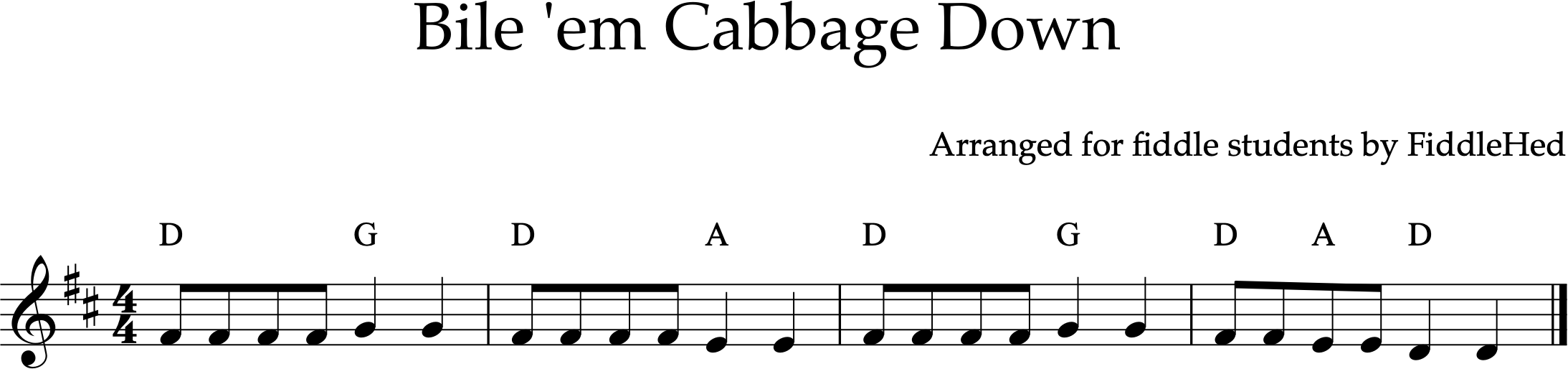
I include full sheet music for those who can already read and for those who are learning to read. If you are an absolute beginner, I suggest you don’t worry about note-reading just yet. Focus on getting a good sound.
Return to the duet
Now you can play the melody part of the duet you learned earlier.
I think it’s still a good idea to play the beginner part because it prepares you for playing backup.
First Quarter: D0-0-0-0-G0-0
Second Quarter: D0-0-0-0-A0-0
Third Quarter: D0-0-0-0-G0-0
Fourth Quarter: D0-0-A0-0-D0-0
Sing, then play
Learning and singing the lyrics will help you to learn and remember the tune.
Bile ’em cabbage down
Bake them hoecakes brown
The only song that I can sing is
Bile ’em cabbage down
You can also practice the whole tune at your own pace with a D drone:
Practice can be approached as a game. If practicing is fun, then you’ll want to keep playing forever. Try playing your first tune in different ways:
- Play it very quietly, like a whisper. Then play it loudly.
- Play it very slowly, then play it fast.
- Try to sing a line, then pluck it on the fiddle.
OK, awesome work. In the next series of lessons, you will integrate bowing with fingering, learn another tune and continue to make the fiddle an extension of your voice.
Continue to Fingering With Bowing >>
Return to top of Module 1.1 >>
Leave a Reply
You must be logged in to post a comment.
I’m confused by the “arranged for fiddle students” sheet music, did I miss an explainer? I don’t need it, though. Almost every “D” label, and every “A” label, is over a note that is either “F” or “E”…
Great points, Adam. The sheet music was compiled in a manner specifically for this program, that’s why it’s dedicated to students/members of FiddleHed. And great point about the letter labels – those indicate chord progressions.
The ‘Support’ tab has great info, including more on this topic – under ‘Fiddle Questions’ there is a drop down tab titled ‘Note Reading’, which has some sections to support you further. Thanks for mentioning it.
Reach out anytime 🙂
This is fun! I like the build up to a faster rythm.
Great to hear your enjoying, Christine 🙂
Hi…Enjoying this step by step approach. Thanks for making it easier! Wondering two things…My bow is making more scratchy-squeaky sounds than it did on open strings. What’s that about? Also sometimes the bow just bounces. It will go away a bit if I put more pressure on, but I’m wondering if that’s the thing to do. Thanks!
Hi Claudia, thanks for reaching out. Wondering how this is going for you now?
Please consider submitting a feedback video so we can more easily see what’s going and provide some ideas to support you. Here’s the page for more details on this: https://staging.fiddlehed.com/support/video-feedback-lessons/
Please also check out the ‘Support’ tab, and ‘Fiddle Questions’ page. Within there, the ‘bowing’ drop down section can support both of these questions you have further. Here’s the page link for easy reference: https://staging.fiddlehed.com/fiddle-questions/
Also, can be handy to tune into the interactive group sessions to address these items together live. The ‘Community’ tab and ‘Group Lesson Central’ page gives further details on these sessions. The Office Hours, Open Practise, and Beginner Group sessions are all good ones for interacting on these topics.
Be great to hear how this is going for you some months later. Thanks for Fiddling with us!
I have successfully learned Bile’em Cabbage Down. With fingering and bowing. Can’t wait for more.
Awesome, Holly!
i appreciate all the practice tips.
jan
Thanks for sharing, Jan. Simple tips make practising more approachable 🙂
Thanks for mentioning this Chris and Michael, we’ll work on getting those video loops functioning.
Im not able to get the video to play, i tried to click on it but it keeps adding and taking away time but not playing. What am i doing wrong?
Ok, i think I’ve got it figured out. (Sorry, just didn’t want to miss anything)
With this lesson and the previous one, I am not getting sound on some of the videos. The first one usually sounds fine, but the extras sometimes play but without sound. What am I doing wrong.
That ‘whoah Nellie’ cartoon made me smile, thank you, and the Star Wars excerpt — thank you so much!
I have a question about the sheet music. The notes are correct, but the letters above them do not correspond with the notes being played or the strings, what are the letters supposed to indicate? I feel like I’m missing something really obvious …
Excellent question! Those are chords, not note names. I need to re-make this sheet music without chords so that it’s not confusing…
I’m having fun playing this tune and am proud that it kind of sounds like music! I start out sounding good but by the end of the tune my bow is wandering back to the bridge. I’m sure it’s like patting your head and rubbing your tummy, I just need to concentrate on bow, strings and sound all at the same time. Thanks for making the lessons fun and easy to understand for a “senior” beginner like me!
Enjoing it immensely…starting to sound like music… how this for a fun practice… play a verse tucka and the next hoedown then back to tucka etc….give it a go big fun
Thanks for the suggestion!! Playing is necessary when learning anything new!
I’ve been enjoying this lesson series so much! However, I’m noticing especially in this exercise that the sound of my fiddle becomes increasingly strangled and buzzy as I move up the scale with fingering. I also find myself accidentally hitting adjacent strings much more often with fingering than I ever did on open strings. I’ll admit that I’m not working with top of the line equipment and the tone problems may have something to do with that, but is there something I can practice to help keep a robust sound even on those F sharps and Gs?
Hi myArmCanFly,
Do you have finger tape on the fiddle? If so, that can cause buzzing with plucking.
If that’s not the case, then try to isolate each note to see if you can work out the kinks. Then play intervals like D1-2, D2-3.