
Mastering I, ii, IV, V, vi Chords Workshop
🧭 Overview
This workshop expands your chord vocabulary by adding the ii (E minor) and vi (B minor) chords to your existing I–IV–V toolkit in D Major. You’ll:
- Learn how to build and play these chords with triads
- Loop through common progressions like Em | D and D | Bm | G | A
- Jam on Swallowtail Jig and a bluegrass take on U2’s “With or Without You” (and yes, that’s U2—because nothing says “fiddle workshop” like emotional Irish rock).
- Transpose everything to G Major using the Nashville Number System
🪜 Learning Steps
🎯 Recap & Context
- This is a continuation of our I-IV-V chord backup workshop
- Review of triads, chord roles, and basic theory of the Nashville Number System
- We’ll build from the D major scale and its steps: 1-2-3-4-5-6-7
🔥 Warm-Up in D Major
- Play the D major scale (say or sing notes as you go)
- Build triads and chords for:
I = D major
- Triad: D0-2-A0-0-D2-0
- Chord: D0A0
- Chord loop: D0-2-A0-0-D2-0 | D0A0-D0A0-D0A0-D0A0-D0A0-D0A0
ii = E minor
- Triad: D1-3-A1
- Chord loop: D1A1-D1A1-D1A1-D1A1
- Easy version: G0D1
IV = G major
- Triad: G0-2-D0-3-A1-3
- Chord: D0A1
V = A major
- Triad 1: A0-2-E0
- Triad 2 (harder): G1-H3-D1
- Chord: D1A0
vi = B minor
- Triad: G2-D0-2 | A1-3-E1
- Chords: Easy = D0A1, Hard = D2A1
❓ What Makes a Chord Minor?
Minor chord = minor third + fifth
Compare:
- D Major Third = D to F# (4 half steps)
- D Minor Third = D to F natural (3 half steps)
Practice both with D drone
Apply to E minor, then contrast with E major
- E Major Third: D1-H3
- E Minor Third: D1-3
Practice both with E drone
Practice singing/playing both with drone to feel the emotional difference
🎵 Song: Swallowtail Jig (ii → I loop)
Progression: Em | D
Practice rhythmically with 6-count triplets
Practice in stages:
- Chords only
- Melody only
- Alternate melody and chords
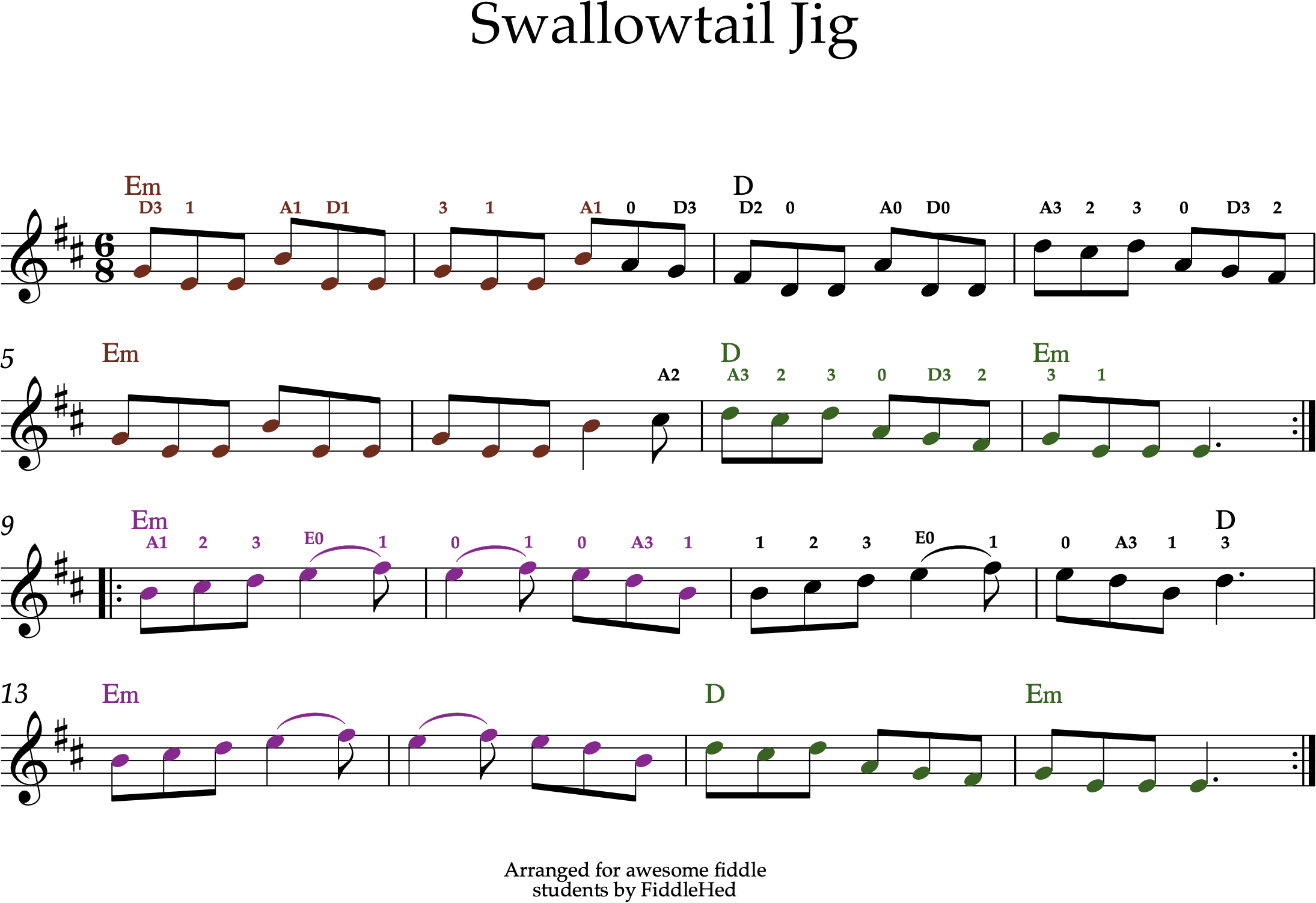
Transpose to G major: Am | G
🎸 Song: With or Without You (U2)
In the workshop I played an incorrect progression for the song. Here’s a video with the correct progression:
Workshop progression (incorrect): D | Bm | G | A (I-vi-IV-V)
I recommend learning the incorrect one anyway. Good practice!
True progression: D | A | Bm | G (I-V-vi-IV)
Try it both ways!
Use:
- Straight eighths
- Hoedown bowing
Practice looping chords, then add melody
🎚️ Transpose Practice
Apply the exact same finger shapes in G major
Workshop progession G | Em | C | D (from D | Bm | G | A)
With or Without You: G | D | Bm | C
Em | D becomes Am | G
Compare how chord feel changes in a new key
💬 Reflect
Can you name all 5 chords in D and G?
Which loop felt most musical or inspiring?
What challenges came up adding ii and vi?
What rhythm will you try next?
🧠 Summary
The ii (Em) and vi (Bm) chords expand your musical expression
Chord-melody alternation is a powerful practice
Transposing loops builds deep fluency
Minor/major triads can share root + 5th — explore the third!
📚 Further Learning
- Practice other tunes with I, ii, IV, V, & vi chords (e.g. Will The Circle Be Unbroken)
- Build your own chord-melody loop on a favorite fiddle tune
- Explore the B minor scale for melodic improv
Related Lessons:
- Practice This One Thing to Unlock Violin Double Stops
- I-IV-V Chord Progression Workshop
- Chords & Melody On Will The Circle Be Unbroken [GPS]